Photograph a room
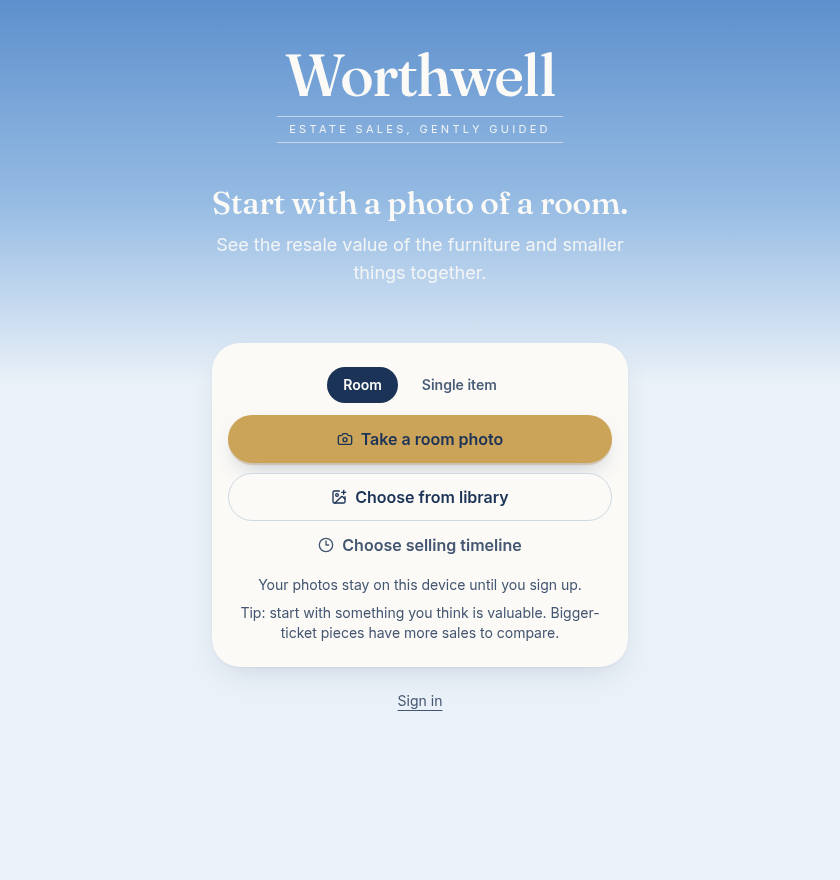
Start with a room photo to see furniture and smaller things together, or snap a single piece you’re unsure about.
Worthwell helps families and solo operators run a first estate sale or liquidation. Photograph a room, review starting prices, and get a plan you can hold — at your own pace.
A private beta, with a first focus on the Hudson Valley, New York.
How it works
You can begin without creating an account. An account is only needed when you want to save your sale and pick it up on another device.
Start with a room photo to see furniture and smaller things together, or snap a single piece you’re unsure about.
You’ll get a fair-value range and a starting price, labeled as an AI estimate until you tap “Looks right” or edit it.
When does everything need to be gone? Will you sell in person, online, or both? Where is the home? You’ll get a simple plan, such as “Your sale in 3 weekends.”
An item board tracks every piece, with a projected total — and money actually sold, kept separate. Export a spreadsheet whenever you need one.
What’s in the app
These are features in the live app today. Anything still being built is marked Coming soon.
Photograph a whole room, or one object. You can add more photos, name the room, and keep going when you’re ready.
Every AI price stays an estimate until you accept or change it. Edit the name, condition, value, or starting price whenever you need to.
See a projected low, expected, and high for the sale, with money already sold shown on its own — not mixed into the forecast.
Choose how soon you’re hoping to sell. If you change that timeline later, Worthwell asks before it recalculates unapproved starting prices.
Each item gets a plain recommendation. If two things look like a set, the app can suggest pricing them together — and you can skip it.
For higher-value pieces, Worthwell looks for comparable listings and keeps only the ones it actually opened. If it can’t find reliable ones, it says so.
Photos remain on the device until you create an account. Sign in with Google or email to continue on your phone and computer.
A timeline-based schedule that lowers prices as the last sale day approaches, with a chance to see, skip, or undo each drop.
A nudge to schedule a pickup when something is large, low-value, and not moving — or already marked Donate.
A home for pricing preferences and listing rules, so your choices stay saved instead of living in a conversation.
Worthwell grew out of a real Hudson Valley estate sale: 406 items, and $6,096 in transactions. That sale is how the product was first shaped — not a promise of what any other sale will bring.
Who it’s for
If you’re sorting a home’s things for the first time, Worthwell gives you prices and a plan without handing the sale — and a large share of it — to a company.
If you’re running a liquidation yourself, you get a single place to catalog rooms, approve prices, and see what the sale is adding up to.
The local starting place is the Hudson Valley in New York. If you’re elsewhere and want to try the private beta, you’re still welcome to join the list.
A quieter pace
Grief makes it harder to concentrate, so Worthwell keeps to one clear step at a time, with a visible next action, and nothing you have to remember from the screen before. The work is the sale — not a reminder of why you’re here.
Private beta
This is a small, early group — not a public launch. Tell us a little about you, and we’ll be in touch when a spot is open. There’s no cost to join the list, and we’ll share any pricing before you’re asked to pay.
For hiring managers
I’m an AI product manager in the Hudson Valley, and I took Worthwell from a ChatGPT-project MVP to a Lovable rebuild in the She Builds cohort. The first version was useful — and it taught me exactly where an AI product can quietly fail people who are already under strain.
The rebuild only says something is running when a real job exists. Finished work is kept if a later step fails, instead of leaving someone waiting on a spinner that isn’t doing anything.
The ChatGPT MVP could invent comps. The rebuild keeps only listings it actually opened, and says when it can’t find a reliable one.
Pricing lives in a deterministic configuration module — fair market value, adjusted for condition and tier, then rounded — not in a prompt that forgets. A Settings page is coming so those choices stay saved.
I design AI products that know when to act, and when to stop and ask. I’m looking for roles — and for teams who want that same care in something they need built.
Questions
A small, early group using Worthwell and telling us what’s missing. Joining the list doesn’t create an account or guarantee a spot; we’ll follow up when there’s room. The live app is already available to try if you’d like to look around first.
That’s the first place we’re focused, because it’s where Worthwell was shaped. If you’re somewhere else and facing a first estate sale, you’re still welcome to join the list.
No. You can start with a photo. Photos stay on your device until you sign up. Create a free account when you want to save the sale and open it on another phone or computer. Guest use has daily limits so the service stays available.
A starting list price begins with a fair market value, then is adjusted for condition and pricing tier and rounded. The result is shown as an AI estimate until you approve or edit it. For higher-value items, the app looks for comparable listings and keeps only ones it actually opened. You can always change a price.
Joining the waitlist is free, and you can try the live app without paying. Free use has some limits. A paid plan for whole-home sales is in the works; we’ll share any pricing before you’re asked to pay.
I’m Genevieve Mitchell, the product manager building Worthwell. You can look through my portfolio, book an intro, or email me.